Subhas Bose and the Indian National Army
INA Memorial, Moirang, Manipur
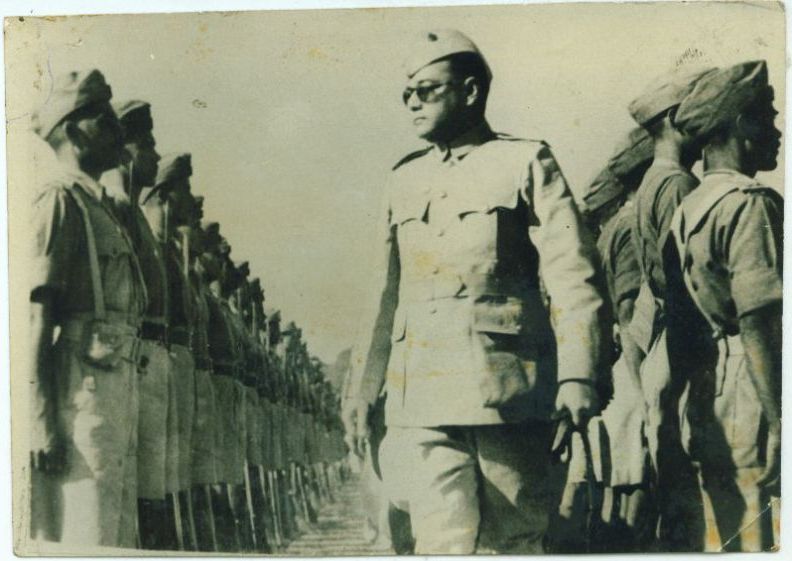
Bose leads the INA alongside Japan; its flag flies at Moirang in April 1944 before defeat at Imphal, and his death in 1945 has been disputed ever since.
Subhas Chandra Bose, twice Congress president, escaped house arrest in Calcutta in January 1941, reached Germany by way of Kabul and Moscow, and in 1943 came by submarine to Southeast Asia. In Singapore he took command of the Indian National Army, raised from Indian prisoners of war after the fall of Malaya, and on 21 October 1943 proclaimed the Provisional Government of Free India. On 30 December 1943 he raised the tricolour at Port Blair; Japan handed the Andaman and Nicobar Islands to his government in name and kept control of them.
In the Japanese offensive on Imphal and Kohima from March to July 1944, INA units fought alongside the Japanese. On 14 April Colonel Shaukat Malik raised the INA flag at Moirang, the first on the Indian mainland, where the INA memorial now stands. The offensive failed, and on the retreat through the monsoon many INA soldiers died of hunger and disease.
Bose was reported killed when his plane crashed at Taihoku in Taiwan on 18 August 1945, and ashes said to be his are kept at the Renkoji temple in Tokyo. The Shah Nawaz Committee of 1956 and the Khosla Commission, which reported in 1974, accepted the crash; the Mukherjee Commission reported in 2005 that there had been no crash, and the government rejected its finding. The West Bengal and central governments released their secret files on Bose in 2015 and 2016 without settling the question.
- war
- political