Lucknow and Begum Hazrat Mahal
The Residency, Lucknow
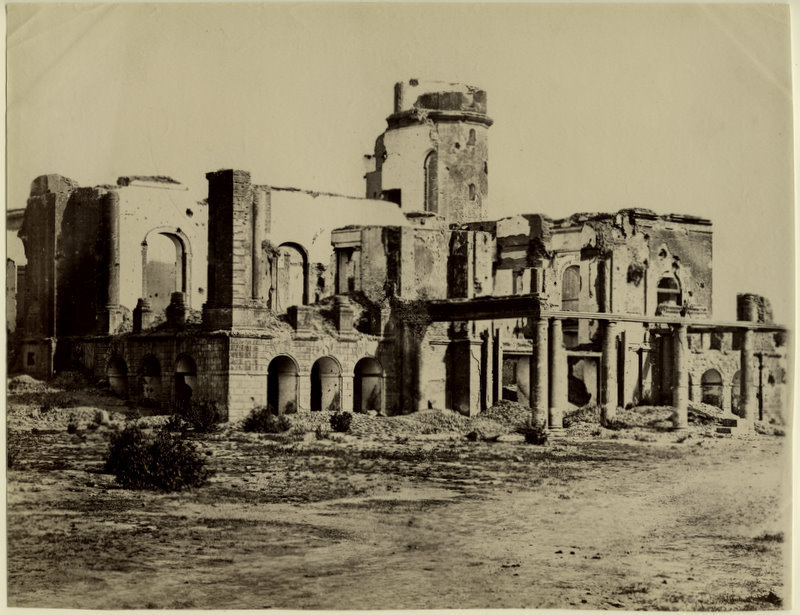
Awadh rises; the British are besieged in the Residency for nearly five months while Begum Hazrat Mahal rules in her son's name until March 1858.
Awadh had been annexed fifteen months before, and the rising there drew in not only the sepoys, many of whom were recruited in Awadh, but its dispossessed taluqdars and peasants. After defeat at Chinhat on 30 June 1857 the British garrison and civilians withdrew into the Residency, where Henry Lawrence was killed in the first days of the siege. Havelock and Outram fought their way in on 25 September but could not get out; Colin Campbell relieved and evacuated the Residency in November.
Begum Hazrat Mahal, a wife of the exiled Wajid Ali Shah, had her young son Birjis Qadr crowned in July and governed in his name. Lucknow fell to Campbell in March 1858. She fought on in the countryside, answered Queen Victoria's proclamation with one of her own, and died in exile in Kathmandu in 1879.
The British kept the ruined Residency as a memorial, its flag never lowered until 1947. Indian historians, Rudrangshu Mukherjee among them, have argued how far the rising in Awadh was a popular revolt rather than a mutiny.
- war
- colonial
- political